Quick answer
The tourist Climate Card still exists. Seoul ended its old 30-day Climate Card program during the 2026 transition to Climate Pass, but the 1-, 2-, 3-, 5-, and 7-day passes for short-term visitors continue.
For most first-time visitors, T-money is the easier default. You can use it when you arrive at Incheon Airport, on public transport across Korea, and on routes that the Climate Card excludes. A Climate Card short-term pass can cost less when you will spend several consecutive days inside Seoul and take enough covered subway and bus journeys.
Quick answer: choose the card that fits your actual route
Choose T-money if any of these describes your trip:
- You want one card for the airport, Seoul, and another Korean city.
- You expect only two or three separate paid journeys on most days.
- Your itinerary uses the Shinbundang Line, GTX, an airport bus, an intercity bus, or routes outside the Climate Card service area.
- You do not want to activate a short-term pass on a light arrival day.
Consider a Climate Card short-term pass if all of these are true:
- Your sightseeing days are consecutive.
- Almost every planned journey is inside the current service area.
- You expect enough separate paid journeys to exceed the pass price.
- You can buy and load the card after reaching Seoul.
Do not choose by trip length alone. A five-day visitor who walks between nearby sights may spend less with T-money than a three-day visitor who crosses Seoul several times each day.
The tourist Climate Card did not disappear in September 2026
The phrase “Climate Card was discontinued” is incomplete. Seoul changed its resident transport-benefit system, while keeping the tourist passes.
| Product | What happened in 2026 | Who it is for |
|---|---|---|
| Climate Card short-term pass | Continues in 1-, 2-, 3-, 5-, and 7-day versions | Foreign tourists and other short-term visitors using covered Seoul transport |
| Prepaid and postpaid 30-day Climate Card | Phased out; the last prepaid cards expire by September 29 and postpaid operation ends September 30 | Former regular users of the 30-day program |
| Climate Pass | Launched September 1 through the K-Pass system | Eligible Seoul residents, not ordinary short-term tourists |
This distinction matters because search results and news headlines often use “Climate Card” for all three. A tourist comparing cards should ignore instructions about K-Pass registration, residence verification, or the old 30-day pass. The relevant product is the Climate Card short-term pass.
Foreign visitors can buy it. Since March 17, 2026, supported machines on Seoul Subway Lines 1 to 8 have accepted internationally issued credit and debit cards for short-term pass purchases and recharging. Seoul says the average international-card service fee is about 3.7 percent.
Climate Card short-term pass vs T-money
| Decision point | Climate Card short-term pass | T-money |
|---|---|---|
| Payment model | Unlimited eligible rides during the selected period | Pay for each journey from a stored balance |
| Available periods | 1, 2, 3, 5, or 7 days | No fixed period |
| Main coverage | Eligible Seoul subway sections and Seoul-licensed buses | Public transport across Korea, plus taxis and participating merchants |
| Incheon Airport arrival | Cannot be used to board Airport Railroad at Terminal 1 or Terminal 2 | The safer choice for the trip into Seoul |
| Routes outside Seoul | Limited and easy to misuse at a boundary | Usually the more flexible option |
| Purchase timing | The short pass starts on the loading date and cannot be loaded in advance | Buy and add a balance when needed |
| Best fit | Consecutive, transit-heavy days inside the covered Seoul network | Light travel, mixed networks, airport arrival, or a multi-city trip |
The Climate Card is not a universal Seoul metropolitan pass. It excludes the Shinbundang Line, GTX, intercity and airport buses, subway sections outside its service area, and buses that are not licensed by Seoul. A red bus seen within Seoul may still be licensed outside the city and therefore excluded.
T-money is less complicated because it works across a much broader transport network. You still need enough balance and must tap correctly, but you do not need to check a special pass boundary before every day trip.
Count journeys, not just days
The short-term Climate Card prices are KRW 5,000 for 1 day, KRW 8,000 for 2 days, KRW 10,000 for 3 days, KRW 15,000 for 5 days, and KRW 20,000 for 7 days. A physical Climate Card costs another KRW 3,000.
Seoul’s published adult subway base fare is KRW 1,550 with a transit card. Using that base fare only, the pass price is exceeded at roughly these counts:
| Pass | Pass price | Approximate base-fare journeys to exceed the pass price |
|---|---|---|
| 1 day | KRW 5,000 | 4 |
| 2 days | KRW 8,000 | 6 total |
| 3 days | KRW 10,000 | 7 total |
| 5 days | KRW 15,000 | 10 total |
| 7 days | KRW 20,000 | 13 total |
These are screening numbers, not a savings promise. Compare the cost of buying the physical cards as well. T-money card prices vary by product, while a physical Climate Card costs KRW 3,000. Longer journeys may add distance charges, and buses have their own fares.
For example, take a three-day visitor who needs to buy either card and expects nine separate subway journeys at the KRW 1,550 base fare. A physical Climate Card plus the three-day pass costs KRW 13,000. A regular T-money card at the operator’s approximate KRW 3,000 price plus nine fares comes to about KRW 16,950. In that example, the Climate Card is about KRW 3,950 cheaper before any international-card fee.
Reduce the same itinerary to six separate journeys and the result changes. The T-money total is about KRW 12,300, compared with KRW 13,000 for the Climate Card. The difference is small, and T-money keeps the broader network. Special card designs, distance charges, and a different mix of bus and subway fares will change both examples.
Most importantly, count fare-paying journeys rather than every vehicle you board. Seoul’s integrated fare system can treat a subway-to-bus or bus-to-subway transfer as one combined journey when you tap correctly and transfer within the allowed time. Counting both vehicles as two full fares makes T-money look more expensive than it is.
A simple test works better than a generic “three rides per day” rule:
- Mark every time you expect to enter the transit system after sightseeing, eating, or returning to your hotel.
- Keep qualifying transfers within the same journey together.
- Remove airport buses, Shinbundang Line trips, GTX trips, and other uncovered segments from the Climate Card count.
- Multiply the remaining base-fare journeys by about KRW 1,550, then compare the result with the pass price.
If the totals are close, T-money is usually the safer choice. A changed route, a long walk between attractions, or one day spent mainly in a single neighborhood can erase a small projected saving.
Check the airport and every route outside central Seoul
The airport direction is the easiest place to make a costly assumption. The Climate Card cannot be used to board Airport Railroad at Incheon Airport Terminal 1 or Terminal 2 for the journey into Seoul. T-money is therefore the practical card to have when you land. Compare the arrival options in Incheon Airport to Seoul: AREX, Bus, or Taxi?.
Current Seoul guidance allows eligible Airport Railroad travel from Seoul toward the airport, but that does not make the pass equally usable in both directions. Recheck the official coverage page before relying on it for departure day.
Also inspect the operator and endpoint, not only the route shown on a map. The Climate Card does not cover every subway line or bus that passes through Seoul. Check carefully if your plan includes:
- the Shinbundang Line or GTX;
- a red metropolitan bus;
- an airport or intercity bus;
- a station outside Seoul;
- a day trip to a destination such as Suwon, Incheon, or Gapyeong.
One uncovered journey does not automatically make the pass a bad buy. It means you need another payment method for that segment. If several days include uncovered travel, T-money becomes the clearer choice. The route test in Hongdae to Gangnam shows how the number of separate journeys, station walks, and late returns can affect that decision.
Buy and activate the card at the right time
Tmoney’s visitor guide says you can buy a regular T-money card at an airport convenience store or ticket machine, then purchase the card and add the first balance in the same place. A regular card costs around KRW 3,000, although special designs can cost more. No ID, registration, or app is required.
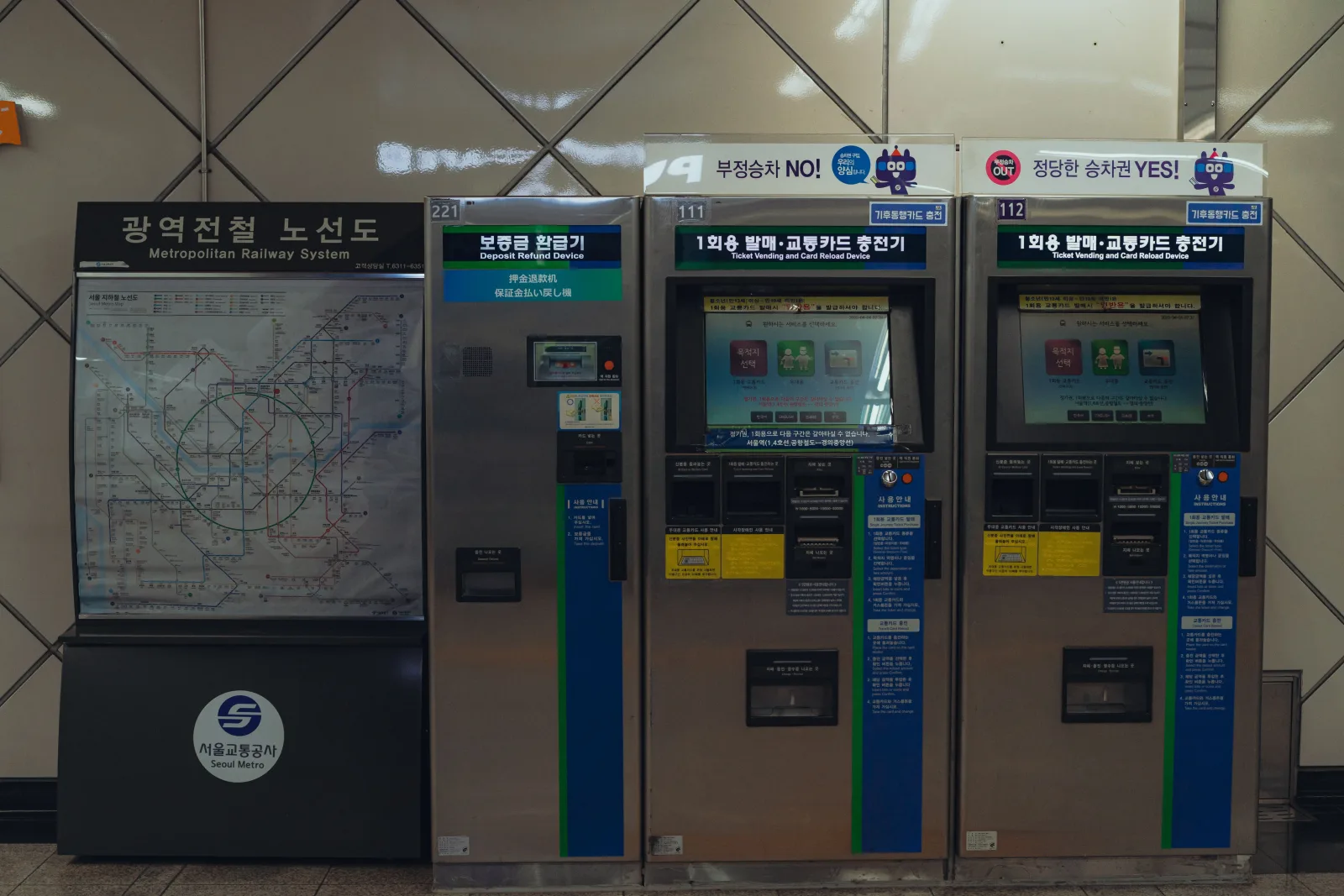
For later reloads, take the card to a convenience-store counter and state the amount, or use a subway-station machine. Some machines accept cash only, so keep a small amount of Korean won until you know which payment method your machine supports. T-money does not require a fixed travel period, so it works well for the airport ride and a quiet arrival day.
The Climate Card Tourist Pass is sold within Seoul. A physical card costs KRW 3,000 before you add the pass. Supported new vending machines on Lines 1 to 8 accept international credit and debit cards, although an international-card service fee may apply. Availability and payment methods can differ at convenience stores and older machines.
Do not load a short-term pass early. Its validity starts on the loading date, not at the first tap or after 24 hours. A 1-day pass loaded late in the evening still expires after the last eligible service that day. Short-term passes cannot be loaded in advance for a later start date.
Each traveler should have a separate card. Registering a physical Climate Card is also required for functions such as refunds, and visitors without a Korean bank account may face a less convenient refund process. Treat the pass as a transport purchase for a planned period rather than loading extra value you hope to recover later.
Final decision checklist
Use T-money as your starting choice if you answer yes to any of these questions:
- Will you travel into Seoul from Incheon Airport using public transport?
- Will you visit another Korean city or take several trips outside Seoul?
- Does your route use the Shinbundang Line, GTX, airport buses, or red metropolitan buses?
- Will you spend some days mostly walking within one neighborhood?
- Would checking the Climate Card boundary add more hassle than the expected saving?
Check a Climate Card short-term pass if your days are consecutive, your routes are covered, and your count of separate paid journeys clearly exceeds the relevant pass price. Keep T-money for any uncovered segment if necessary.
Before buying either card, map the actual hotel-to-attraction journeys. That ten-minute check is more reliable than choosing from the number of days printed on the pass. If the rest of the trip is still undecided, start with First Time in Seoul: What to Plan Before You Book.
Official sources
- Seoul Metropolitan Government: Climate Card prices, coverage, and purchase rules
- Seoul Metropolitan Government: 2026 end dates for the 30-day Climate Card and continuation of short-term passes
- Seoul Metropolitan Government: Climate Pass launch
- Seoul Metropolitan Government: International card payments for foreign visitors
- Seoul Metropolitan Government: Subway fares and transfer rules
- VISITKOREA: Transportation Cards
- Tmoney: Transit card guide for visitors
Image credits
- Seoul subway ticket vending and transit card reload machines — Photo by Theodore Nguyen on Pexels, Pexels License. Resized proportionally to 1600px and converted to WebP without cropping or overlays.
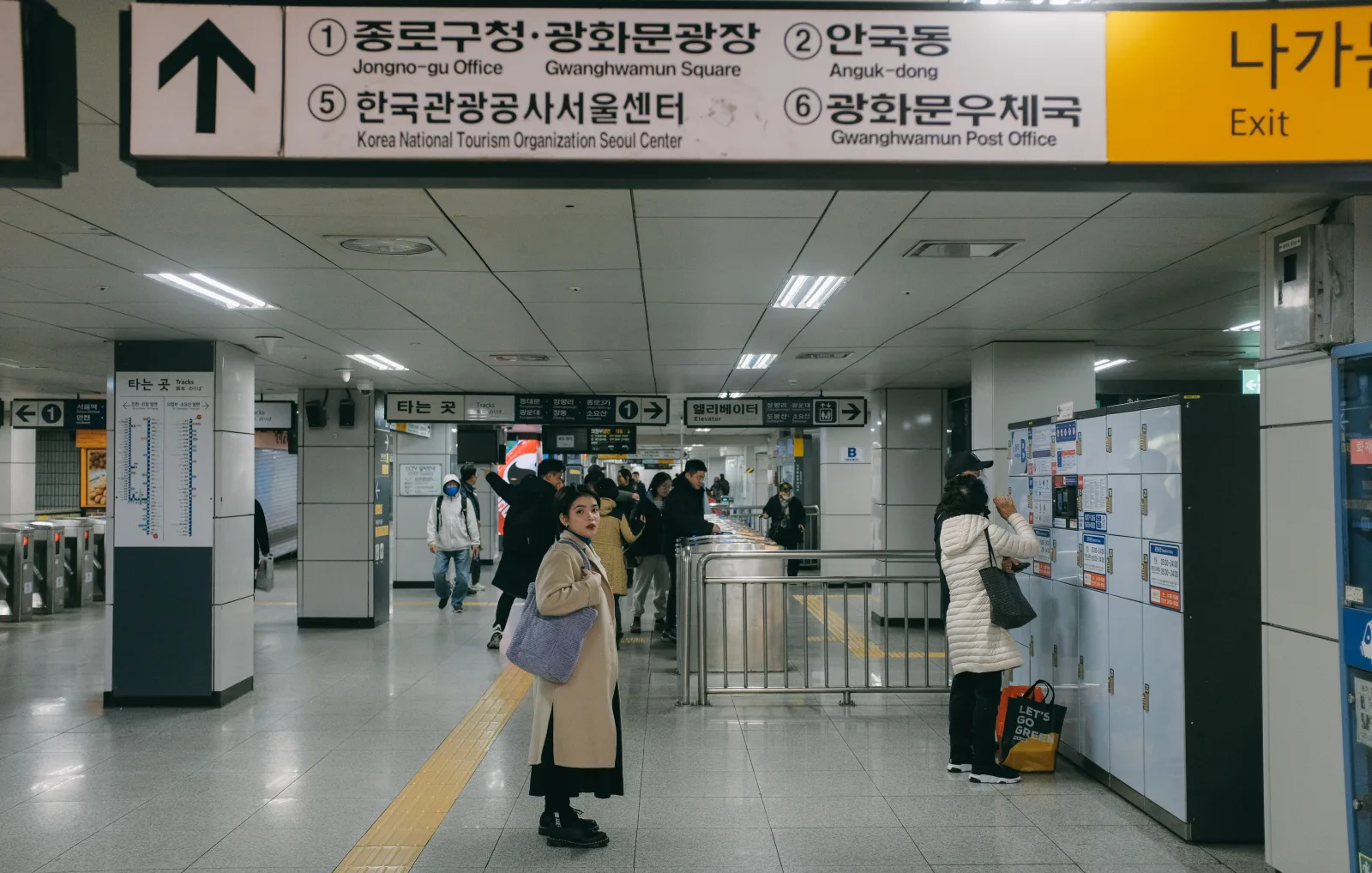
- Jongno 3-ga Station concourse — Photo by Huy Phan on Pexels, Pexels License. Resized proportionally to 1600px and converted to WebP without cropping or overlays.