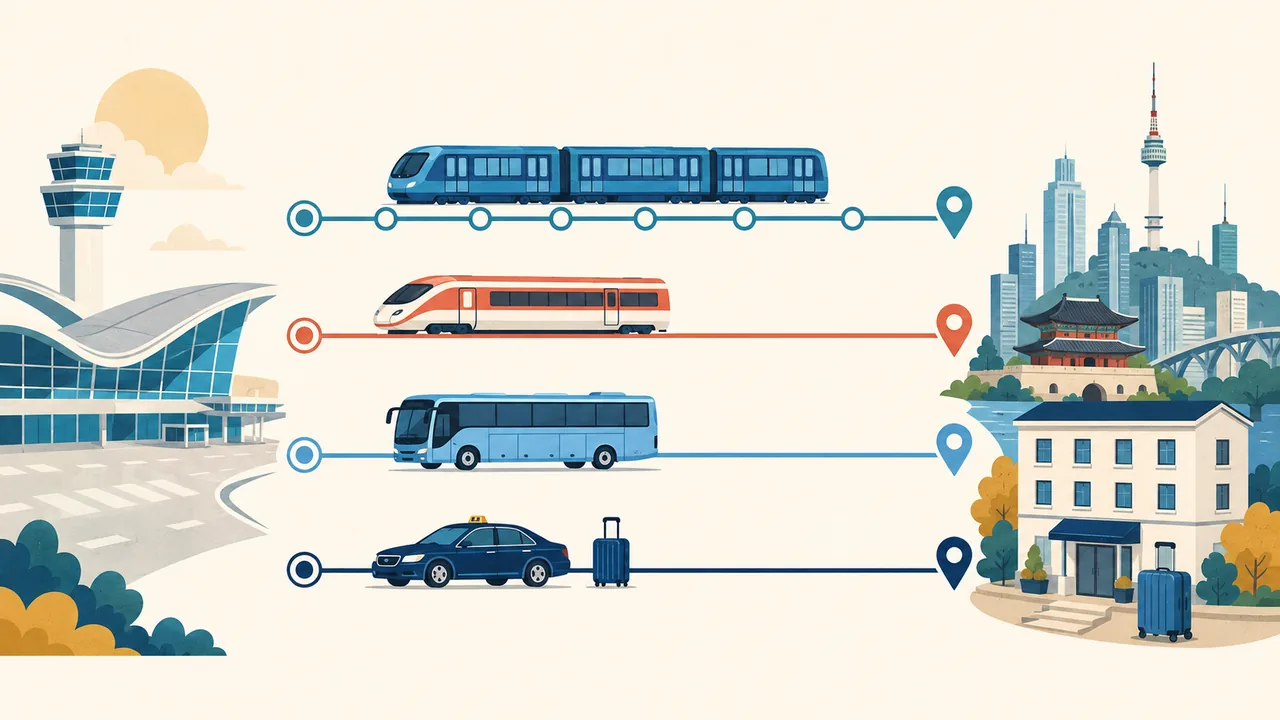
The best way from Incheon Airport to Seoul depends less on which vehicle is fastest and more on what happens after you get off. A train can reach Seoul quickly but leave you with a transfer and stairs. A bus may take longer in traffic but stop near your hotel. A taxi costs more, yet it can be the simplest choice for a group with several suitcases.
Quick answer
Take the AREX All-Stop Train for a direct ride to Hongdae or a low-cost trip to Seoul Station. Choose the AREX Express Train when you want an assigned seat and a nonstop ride to Seoul Station. Check an airport bus when it stops close to your actual hotel. Consider a taxi for a late arrival, limited mobility, or a group that values a door-to-door ride, but match the taxi type to your exact number of passengers and bags before relying on it.
Do not choose until you have checked your terminal, hotel address, final stop, and arrival time. The final leg to the hotel can matter more than a small difference in the airport journey.
Compare the four options first
| Option | Best starting point | Main trade-off | Check before choosing |
|---|---|---|---|
| AREX All-Stop Train | Hongdae, a lower fare, or a useful transfer station | More stops and ordinary metro-style travel | Whether the station exit and hotel walk work with luggage |
| AREX Express Train | Seoul Station with an assigned seat and no intermediate stops | A separate ticket and another journey if the hotel is elsewhere | How you will travel from Seoul Station to the hotel |
| Airport bus | A current route stops near the hotel | Travel time changes with traffic | Exact route, terminal stop, final city stop, and service time |
| Taxi | Door-to-door travel, especially for a group or heavy luggage | Usually the highest total cost, with traffic and surcharges adding uncertainty | Taxi type, late-night surcharge, tolls, and the Korean hotel address |
The AREX name causes avoidable confusion. The All-Stop Train and Express Train use the same airport railway corridor, but they solve different problems. The All-Stop Train serves intermediate stations such as Hongik University. The Express Train skips them and runs to Seoul Station.
Choose by hotel area, not by a citywide winner
Hongdae: start with the All-Stop Train
The All-Stop Train is the first option to check when your hotel is genuinely close to Hongik University Station. It reaches that station without the Seoul Station backtrack required by the Express Train.
The word “Hongdae” can cover a wider area than the immediate station exits. Before relying on the direct rail connection, map the walk from the correct Hongik University Station exit to the hotel entrance. If that final walk is long, steep, or awkward with luggage, compare an airport bus or taxi instead.
Myeongdong: compare the final transfer with the bus stop
Neither AREX train goes directly to Myeongdong Station. Both can take you to Seoul Station. From there, you still need another leg by subway, taxi, or another local connection.
This is where headline train times can mislead. The Express Train is nonstop and has assigned seating, but its advantage may shrink if you then navigate Seoul Station with large bags. The All-Stop Train costs less, but it creates the same final Seoul Station decision.
Check the airport bus search using your hotel name or nearby stop. If a current bus stops within an easy walk of the hotel and runs at your arrival time, avoiding the station transfer may be worth the traffic risk. If the bus stop is not close, an AREX train followed by a short taxi from Seoul Station can be a practical middle option.
If you are still choosing accommodation, compare the exact station side in our Myeongdong hotel guide. A hotel near Myeongdong Station and one nearer Euljiro can lead to different final routes.
Gangnam: test the bus and taxi before accepting two transfers
Gangnam is south of the Han River and is not on the Airport Railroad. A rail plan therefore continues beyond the airport train, often with at least one subway transfer or a taxi from a rail station.
Search for a current airport bus stop near the hotel, then compare the full journey with a taxi. A solo traveler with light luggage may still prefer rail for cost control. A family or small group may decide that fewer transfers justify the taxi fare. Traffic affects both road options, so do not treat a scheduled bus time or a map estimate as a guarantee.
Our Myeongdong, Hongdae, and Gangnam comparison can help if the airport transfer is changing where you want to stay.
AREX All-Stop Train: useful when the stop is the destination
Choose the All-Stop Train when one of its stations already solves most of your journey. Hongik University Station is the clearest example for many visitors. Seoul Station can also work when your next connection is simple.
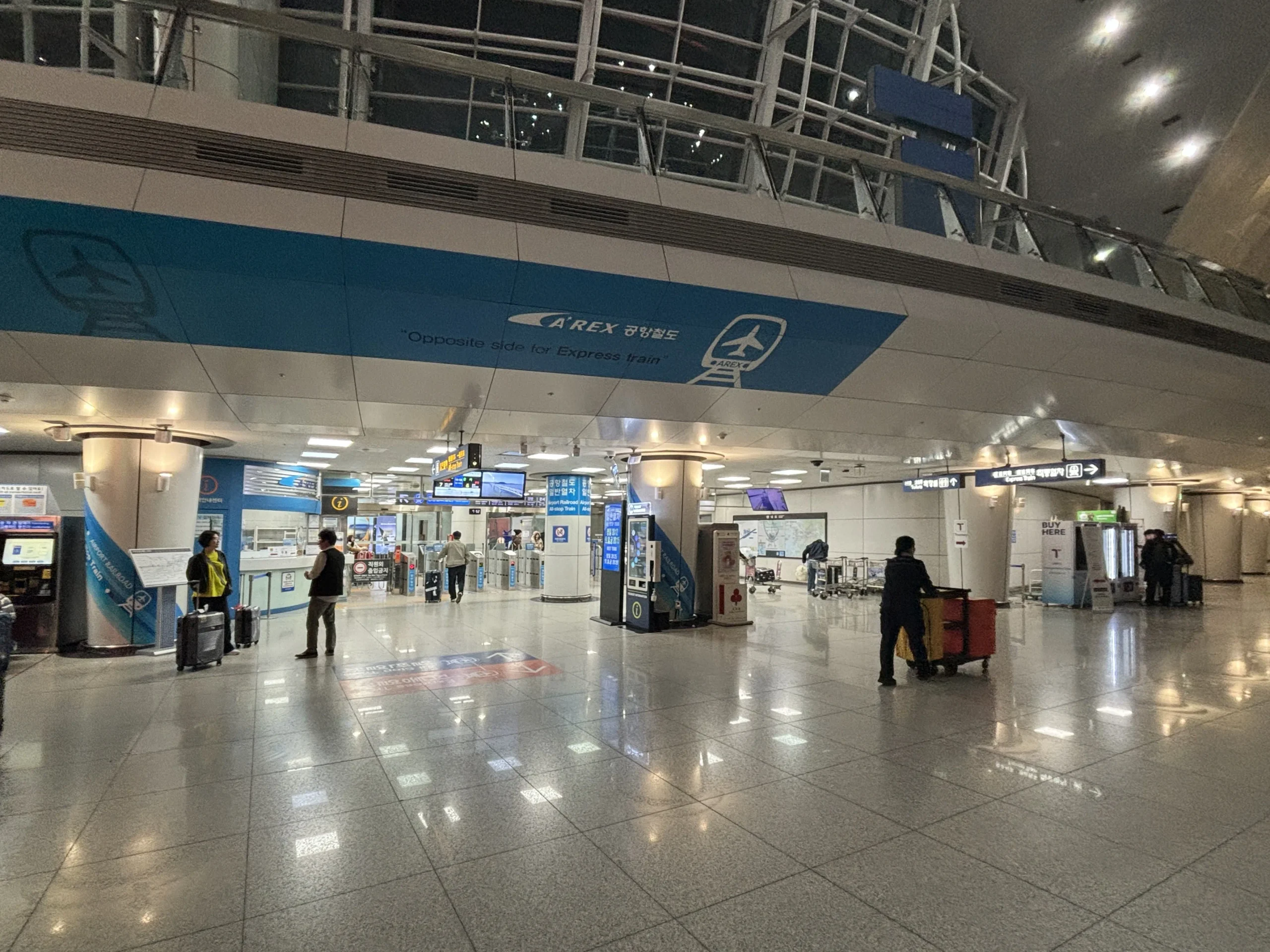
Seoul’s official English guide currently lists the journey to Seoul Station at about 59 minutes from Terminal 1 and 66 minutes from Terminal 2. It lists one-way fares in the KRW 4,150 to KRW 4,750 range. These are useful comparison figures, not a promise for a future travel date.
This is an ordinary all-stop rail service rather than an airport-only reserved-seat train. Ask yourself whether you are comfortable standing for part of the ride and moving your luggage through a busy station. The lower fare is less helpful if the final transfer is the hardest part of your arrival.
AREX Express Train: choose it for the seat and Seoul Station
The Express Train runs nonstop from both airport terminals to Seoul Station and requires its own ticket. AREX currently lists a 43-minute journey from Terminal 1 and 51 minutes from Terminal 2. The listed fare is KRW 13,000 for an adult and KRW 9,500 for a child.
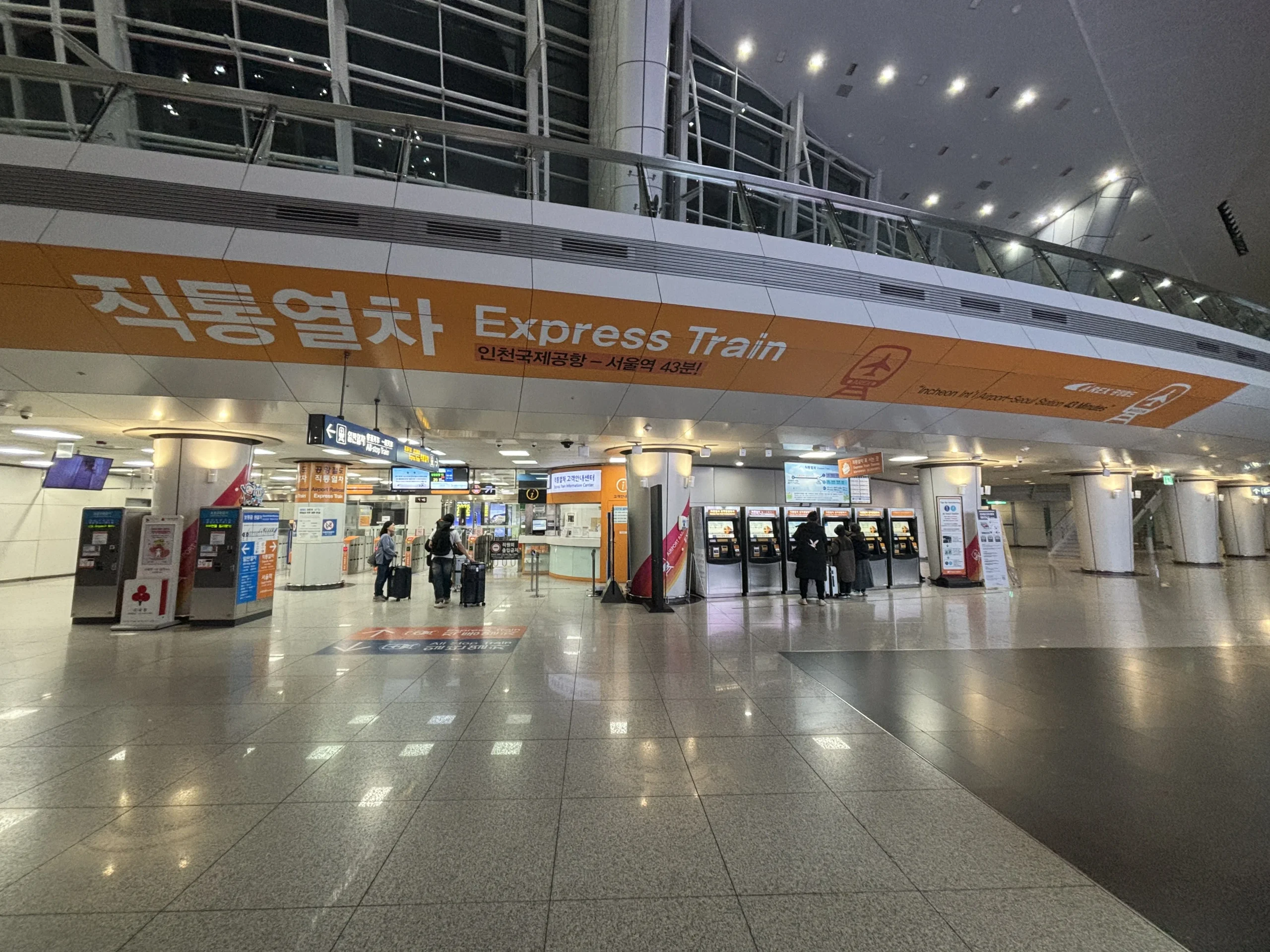
Its practical advantages are assigned seating and airport-oriented facilities, including luggage storage. That can make the first hour after a long flight calmer. It is not automatically the fastest door-to-door option if your hotel is in Hongdae, Gangnam, or another area that requires you to continue from Seoul Station.
Before buying, plan the next leg from Seoul Station. If you will immediately take a taxi, save the hotel’s Korean address. If you will use the subway, check the full station route with luggage rather than looking only at the number of stops. If rail access is the reason to stay there, compare the Seoul Station hotel guide for AREX, KTX, and luggage.
Airport bus: judge it by the hotel stop
An airport bus is most convincing when the city stop is close to the hotel. It can help you avoid carrying luggage through a rail transfer, but you still need to check what the specific operator accepts. The trade-off is road traffic and a timetable that can change.
Use the Incheon Airport bus search shortly before the trip. Search the hotel name, neighborhood, or route number, then verify:
- whether the bus leaves from Terminal 1, Terminal 2, or both;
- the airport boarding location;
- the exact Seoul stop and which side of the road it uses;
- the walk from that stop to the hotel entrance;
- the last practical departure after immigration and baggage collection;
- the current luggage allowance and whether unusually large items are accepted.
Do not rely on an old blog post for a route number. Airport bus routes, stops, and timetables can change. Incheon Airport also publishes separate late-night bus pages for each terminal, but a late-night route may stop in a broad part of Seoul rather than near your hotel. Treat it as a new route-planning question, not as a direct replacement for a daytime hotel bus.
Taxi: simplest at the curb, but check the fare conditions
A taxi removes the station transfer and hotel walk. That can matter after a late flight, with young children, for a traveler who cannot manage stairs easily, or when several people are sharing the cost.
Use the designated taxi stands outside the arrivals area. Incheon Airport warns about illegal solicitation and overcharging by vehicles posing as taxis. The official airport guide lists the taxi stand numbers for both terminals and separates standard, deluxe or jumbo, and international taxi services.
The fare depends on the taxi type, destination, traffic, and applicable charges. The airport currently states that late-night surcharges apply between 22:00 and 04:00, with the percentage changing by time and taxi type. Ask whether tolls or other charges are included when you use a quoted or section fare.
Save the hotel name and address in Korean before landing. Show the exact branch if a hotel brand has more than one Seoul property.
What to do after a late arrival
Do not use your scheduled landing time as the transport departure time. Immigration, baggage collection, customs, and finding the platform or bus stop all take time.
If your flight arrives near the end of normal rail or bus service, prepare two plans:
- Plan A: the last train or the bus that still leaves enough time after baggage collection.
- Plan B: a current late-night bus plus a workable final connection to the hotel, or a taxi from the official stand.
Check the official AREX journey planner and the separate Express Train timetable for your terminal and travel date. Do not rely on a last-train time copied from an older article.
Check both plans again on the day of travel. A late-night bus to a central stop is only useful if you know how you will complete the trip from that stop to the hotel.
A five-minute check before you pay
Open the hotel address and answer these questions:
- Which airport terminal will you use?
- Which train station or bus stop is closest to the hotel entrance?
- Does the final route include stairs, a long passage, or a difficult street crossing?
- Will the service still be running after a realistic arrival buffer?
- How much luggage can each traveler move without help?
- Will the selected taxi type fit every passenger and bag?
- Does sharing a taxi change the cost comparison enough to justify a direct ride?
For a group, compare the total taxi estimate, including likely tolls and surcharges, with the combined train or bus fare for everyone in your party.
If the answers are unclear, choose the option with the simplest final leg rather than the shortest advertised airport time. For a first Seoul trip, arriving at the right hotel entrance with manageable luggage is the result that matters. If check-in or checkout leaves a gap with your bags, use the Seoul luggage-storage guide before adding another stop.
Official sources
- AREX: Express Train
- AREX: All-Stop Train Fare
- AREX: Journey Planner
- AREX: Express Train Timetable
- Seoul Metropolitan Government: Getting to Seoul from Incheon Airport
- Incheon International Airport: Bus Search
- Incheon International Airport: Seoul Late-Night Buses from Terminal 1
- Incheon International Airport: Seoul Late-Night Buses from Terminal 2
- Incheon International Airport: Taxi Guide
- Seoul Metropolitan Government: Taxi
Image credits
- AREX All-Stop Train concourse at Incheon Airport Terminal 1, photo by MNXANL, licensed under CC BY-SA 4.0.
- AREX Express Train concourse at Incheon Airport Terminal 1, photo by MNXANL, licensed under CC BY-SA 4.0.


Both photographs were converted to WebP without cropping or resizing.