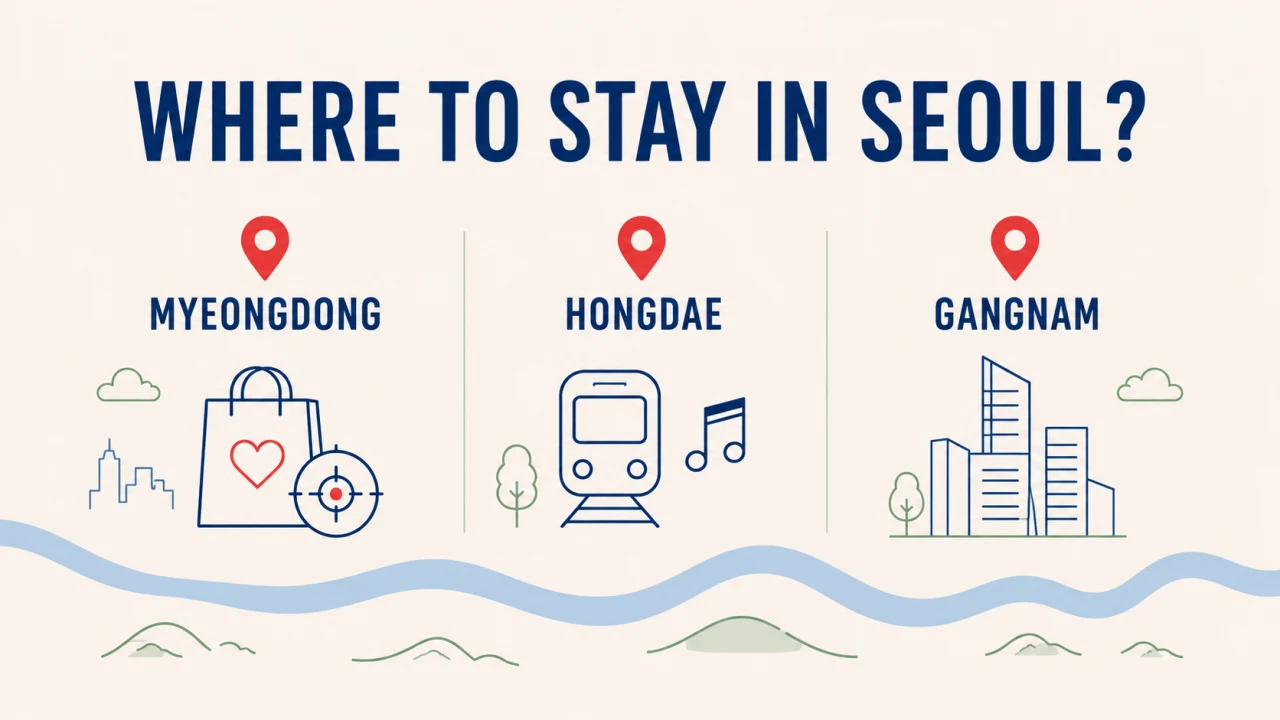
Myeongdong, Hongdae, and Gangnam can all work for a first trip to Seoul. They do not, however, create the same trip.
Your hotel area decides which journeys you repeat every day: the airport arrival with luggage, the ride to your first stop, and the trip back after dinner. A hotel that looks central on a city map may still be awkward for the places you actually want to visit.
Quick answer Choose Myeongdong if most of your plans are in central Seoul. Choose Hongdae if the Airport Railroad and lively late evenings matter to you. Choose Gangnam if COEX, Jamsil, and other places south of the Han River make up a large part of your itinerary.
Then check the exact hotel entrance. A shorter walk to the right station can matter more than the neighborhood name.
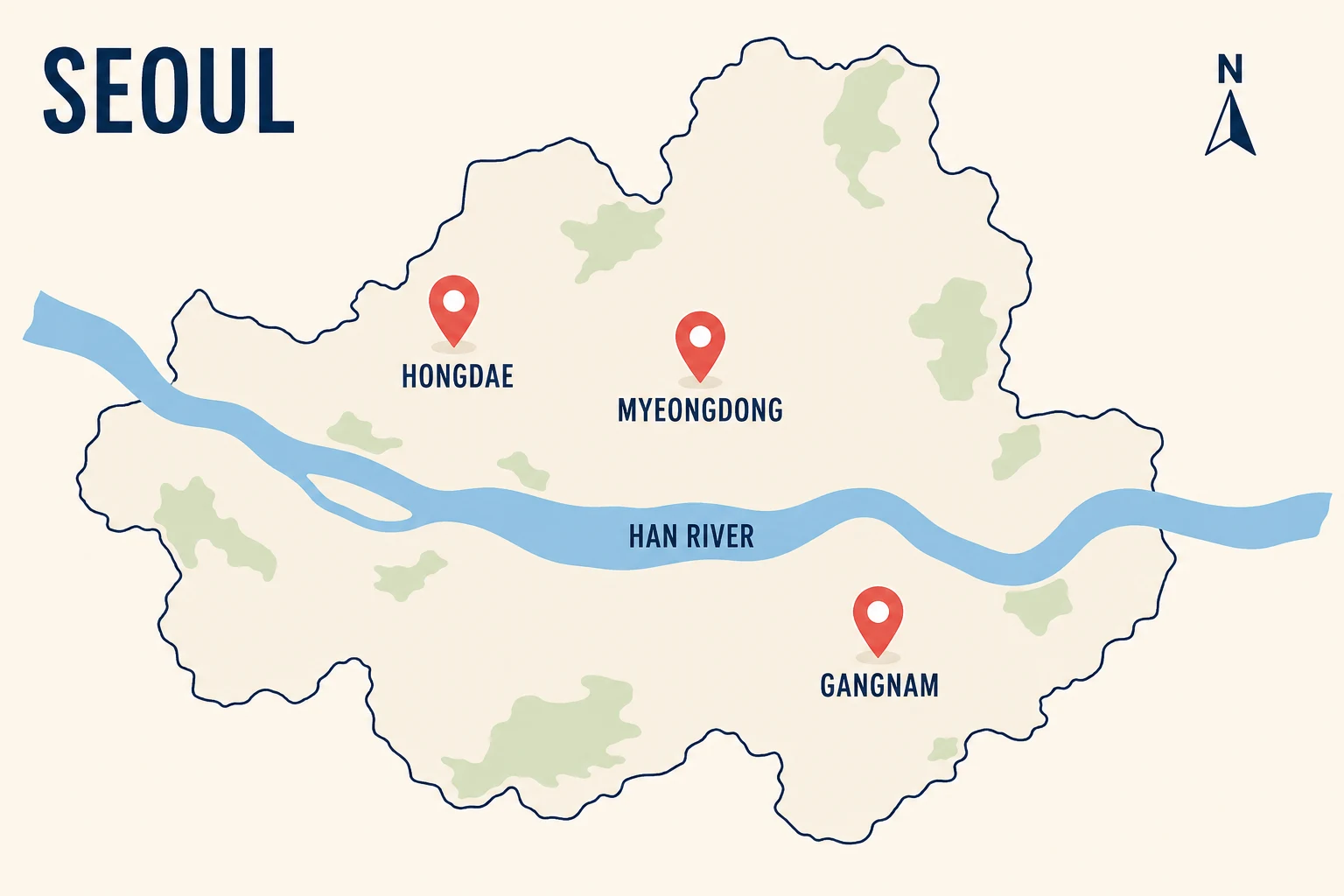
Use this map to get your bearings before comparing the details. Hongdae is west of Myeongdong, and both are north of the Han River. Gangnam is southeast of Myeongdong on the south side of the river.
The quickest way to choose
| Area | Best fit | Airport arrival | Evening around the hotel | Main compromise |
|---|---|---|---|---|
| Myeongdong | First-time sightseeing focused on palaces, markets, Namsan, and central Seoul | Compare train transfers, airport buses, and the final walk to the hotel | Shopping streets, restaurants, and plenty of visitor services | Repeated trips to Gangnam or Jamsil can make the location feel less central |
| Hongdae | Travelers who value Airport Railroad access, cafés, music, and late dinners | Hongik University Station is served by the Airport Railroad | The area stays active late and has a strong youth-culture character | Palace days and southern Seoul days pull you away from the neighborhood |
| Gangnam | Trips built around COEX, Jamsil, business appointments, or southern Seoul | Check the whole route carefully because “Gangnam” covers a large area | Restaurants, shopping, and nightlife vary by station district | Central palace and market days usually mean more cross-city travel |
This is a route decision, not a contest for the most famous neighborhood. Before using the table, mark the places you would be disappointed to miss. The cluster with the most nights, early starts, or fixed reservations should carry the most weight.
If you are still deciding what to book first, read First Time in Seoul? Make These 4 Decisions Before You Book Everything. It explains why the accommodation area should come before the hotel shortlist.
Choose Myeongdong for a central first trip
Myeongdong is the easiest of the three to recommend when a first itinerary is concentrated north of the Han River. Visit Seoul describes it as a district for shopping, commerce, banking, and culture. Myeongdong Station is on Line 4, while the wider area can also be reached from Euljiro 1-ga Station on Line 2.
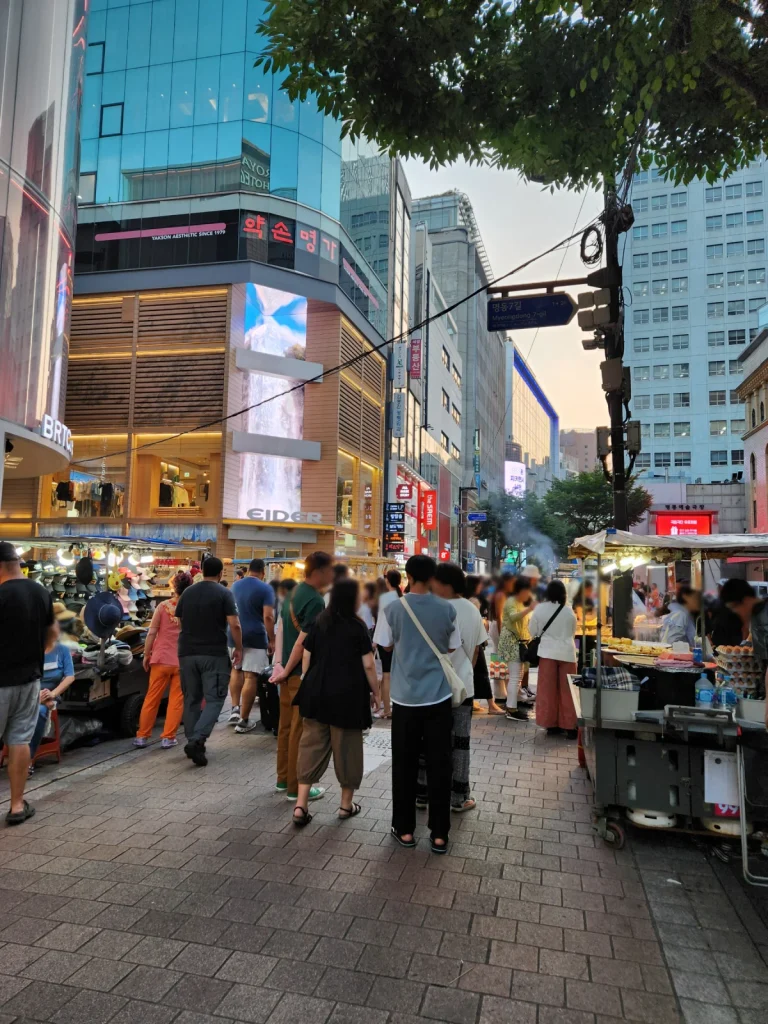
That gives you more than one possible station area when comparing hotels. A property near Myeongdong Station may suit routes toward Seoul Station, Dongdaemun, or the Namsan side of the neighborhood. A property closer to Euljiro 1-ga may fit Line 2 journeys better. Both may be advertised as “Myeongdong,” so the label alone is not enough. If Myeongdong is ahead, compare the Myeongdong hotel shortlist by station and room fit.
Myeongdong is a strong fit if several of these are true:
- Your list includes Gyeongbokgung, Bukchon, Insadong, Namdaemun, Namsan, or markets in central Seoul.
- You want restaurants and shops close to the hotel without planning a separate evening destination every night.
- You prefer a visitor-oriented area where tourist information and familiar hotel services are easy to find.
- Your southern Seoul plans take up one day rather than most of the trip.
The tradeoff appears when Gangnam, COEX, Jamsil, or Seongsu keeps returning to the plan. One trip south is ordinary. Crossing the city for the same cluster on several days suggests that Myeongdong is not as central for your trip as it looks on a map.
Before booking, inspect the terrain and the station exit. The Namsan side of the district can involve slopes, and a route that feels short without bags can be tiring on arrival day.
Choose Hongdae for the airport connection and late evenings
Hongdae changes the arrival equation. Visit Seoul lists Hongik University Station on Line 2, the Gyeongui-Jungang Line, and the Airport Railroad. For a traveler arriving at Incheon Airport, that makes the station worth checking before considering a rail transfer elsewhere in Seoul.
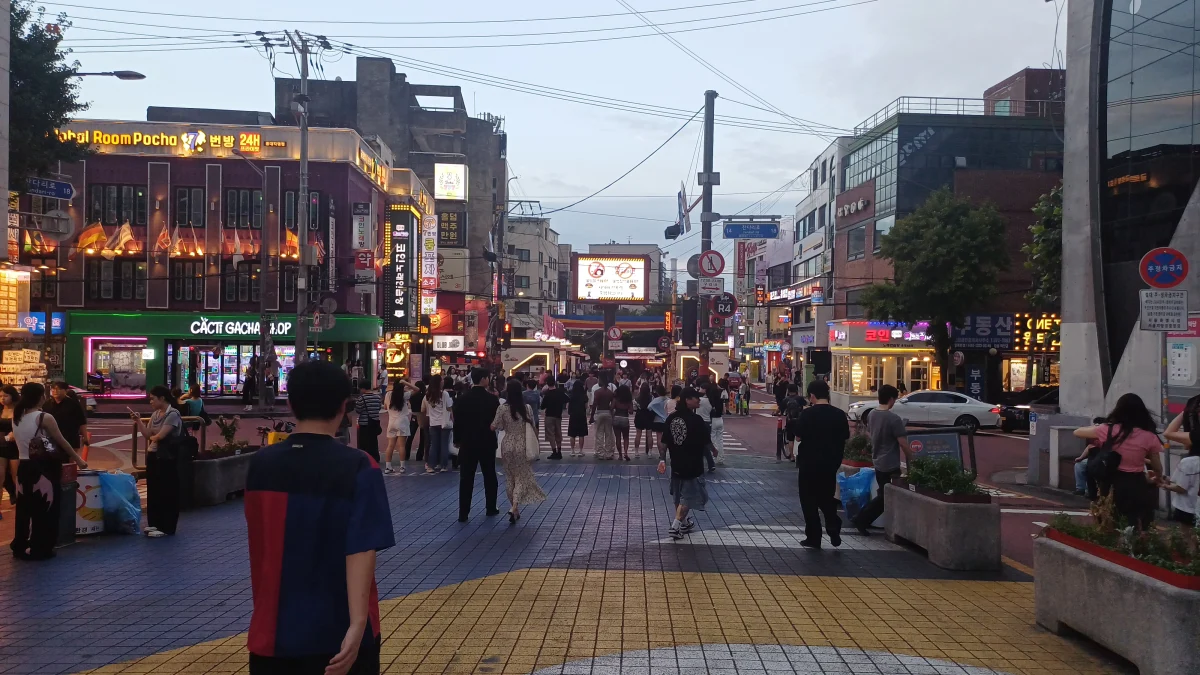
The neighborhood also has a distinct evening identity. Visit Seoul describes Hongdae through music, art, shopping, and nightlife. Staying nearby is useful when those are part of the trip, because the last journey of the day becomes a walk rather than another ride across the city.
Hongdae is a strong fit if several of these are true:
- A simple rail route from the airport is high on your list.
- You expect to spend more than one evening around Hongdae, Yeonnam, Sinchon, or the western side of Seoul.
- Cafés, live music, casual shopping, and late dinners matter as much as early sightseeing.
- You are comfortable taking Line 2 or transferring for central attractions.
The word “Hongdae” covers more than the busiest streets near Hongik University Station. A hotel may be in a quieter part of Yeonnam or closer to another station exit. That can be a benefit, but only if you check the walk to the Airport Railroad platform you plan to use. A nearby exit does not always mean a short indoor walk to every line.
Hongdae loses some of its advantage when most days begin around the palaces or end in Gangnam and Jamsil. The airport journey happens twice. The trip back to the hotel happens every night.
Choose Gangnam when southern Seoul is the trip, not a side visit
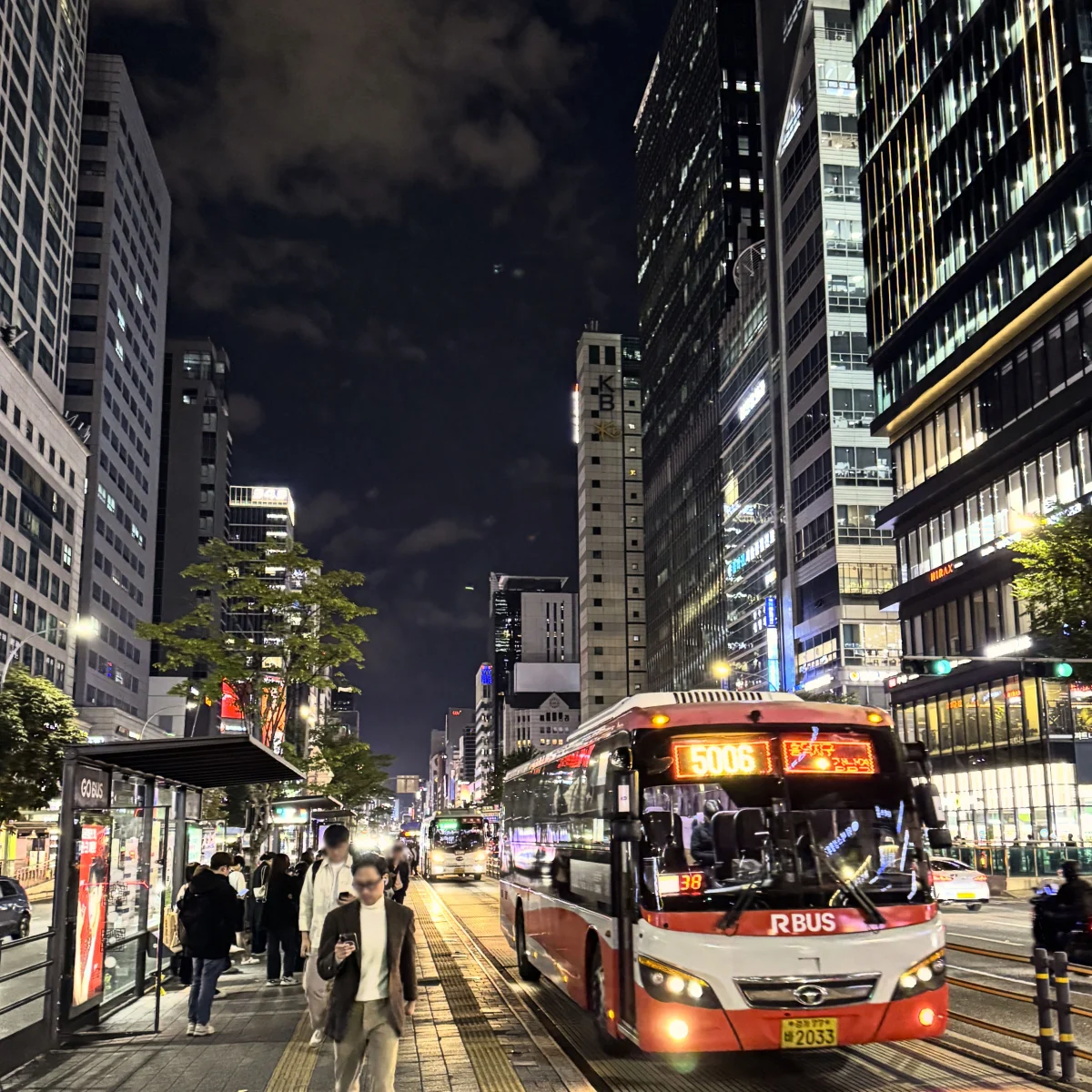
“Gangnam” needs the most careful reading because it can mean Gangnam Station, Gangnam-gu, or a much broader group of neighborhoods south of the Han River. A hotel near Gangnam Station is not automatically close to COEX, and a COEX-area hotel is not the same choice as one near the nightlife around Gangnam Station.
Visit Seoul treats Gangnam as a broad visitor area and groups major southern destinations around Gangnam Station, Samseong, COEX, and nearby districts. If your fixed plans are in this part of the city, staying south of the river can remove repeated cross-city journeys. If Gangnam is ahead, continue with the Gangnam hotel shortlist to compare the hotel options against the southern Seoul journeys you expect to repeat.
Gangnam is a strong fit if several of these are true:
- COEX, Bongeunsa, Jamsil, Lotte World, or southern Seoul appointments anchor multiple days.
- You have an event, conference, concert, clinic visit, or business meeting with a fixed southern location.
- You prefer to return to restaurants and nightlife south of the river.
- Central sightseeing is one planned day rather than the default start of every day.
The compromise is straightforward: a classic palace, Bukchon, Insadong, and market itinerary is centered elsewhere. Line 2 is useful for many journeys, but “on Line 2” does not make every destination close. Count the full door-to-door route and any transfers.
For Gangnam, choose the station district before the hotel. Gangnam Station, Samseong, Seolleung, Sinsa, and Jamsil support different itineraries even when a booking site places them under one broad Seoul category.
Compare the hotel door, not just the area
Once one neighborhood is ahead, compare two or three real hotels in a route app. Seoul’s official English transportation guide points visitors to Naver Map and Kakao Map for route planning and public transport information.
Run these five checks:
- Search from the airport terminal to the hotel at your expected arrival time.
- Check the walk from the station exit to the hotel entrance with luggage in mind.
- Route the hotel to the first stop on two different sightseeing days.
- Route one likely dinner or evening area back to the hotel.
- Check the morning route for any fixed reservation, event, or day trip.
Use the hotel’s Korean name and address when possible. Similar English hotel names and branches can lead you to the wrong pin.
Incheon International Airport publishes separate guidance for buses, trains, and taxis or call vans. Check that official information again shortly before travel. Routes, boarding points, and operating details can change, and the best option depends on the exact hotel rather than the neighborhood alone.
Three sample decisions
Consider how the answer changes with the itinerary.
Trip A: Four nights, with palace sightseeing, Namsan, a market day, and one afternoon in Gangnam. Myeongdong is the sensible starting point because the central journeys repeat and the southern journey does not.
Trip B: Three nights, arriving at Incheon Airport, with two late evenings in Hongdae and Yeonnam plus one palace day. Hongdae has the clearer advantage. The airport connection and the final walk after dinner both serve the same choice.
Trip C: Five nights, with a COEX event, a Jamsil concert, and meetings around southern Seoul. Gangnam or another southern station district deserves priority. Staying in Myeongdong simply because it is often called central would create the wrong kind of convenience.
These are planning examples, not fixed rules. Mobility needs, room price, group size, and a particularly good hotel can change the answer. The aim is to know what you are trading away.
The final decision
Choose Myeongdong for a central first-time itinerary. Choose Hongdae when Airport Railroad access and late evenings in western Seoul matter. Choose Gangnam when southern Seoul holds several of your fixed plans.
If two areas still look equal, book the hotel with the easier real-world route: fewer transfers, a shorter luggage walk, and a better journey home at night. That is usually more useful than choosing the neighborhood with the strongest reputation.
Continue with the Where to Stay in Seoul hub as more hotel and neighborhood guides are added.
Official sources
- Visit Seoul: Explore by Area
- Visit Seoul: Myeongdong
- Visit Seoul: Myeongdong area access
- Visit Seoul: Hongdae
- Visit Seoul: Gangnam Area
- Seoul Metropolitan Government: Public Transportation
- Incheon International Airport: Public Transportation
Image credits
- Myeongdong 7-gil — Photo by SKTakek on Wikimedia Commons, CC0. Resized and converted to WebP.
- Hongdae Red Road — Photo by Striker9498 on Wikimedia Commons, CC0. Resized and converted to WebP.
- Gangnam Station boulevard — Photo by Youngjin on Wikimedia Commons, CC BY-SA 4.0. Resized and converted to WebP without cropping.


