Quick answer
Use Line 2 when you want the most predictable trip. A current station-to-station search showed about 39 minutes, but allow roughly an hour from your hotel door to your actual Gangnam destination unless both ends are close to the right exits. Check a taxi when several people are sharing the ride, you are carrying heavy or awkward bags, or the last useful train has passed. Traffic and late-night surcharges can remove the taxi’s apparent advantage.
The simplest way from Hongdae to Gangnam is usually a direct ride on Seoul Subway Line 2 from Hongik University Station to Gangnam Station. You do not need to transfer. The train itself is simple. The walks at both ends are what make the full trip longer than the time shown between the two stations.
One visit to Gangnam does not make Hongdae a bad place to stay. If your itinerary sends you south of the Han River early or late on several days, compare the repeated travel time with a Gangnam hotel before booking.
The easiest subway route is direct Line 2
At Hongik University Station, follow signs for Line 2 rather than the Airport Railroad or Gyeongui-Jungang Line. Line 2 runs in both directions around a loop. For the shorter route to Gangnam, choose the side that reaches Hapjeong and then Dangsan. Do not take the side that reaches Sinchon first. Confirm Gangnam on the route display or in the Seoul Subway app, then stay on the same train until Gangnam Station.
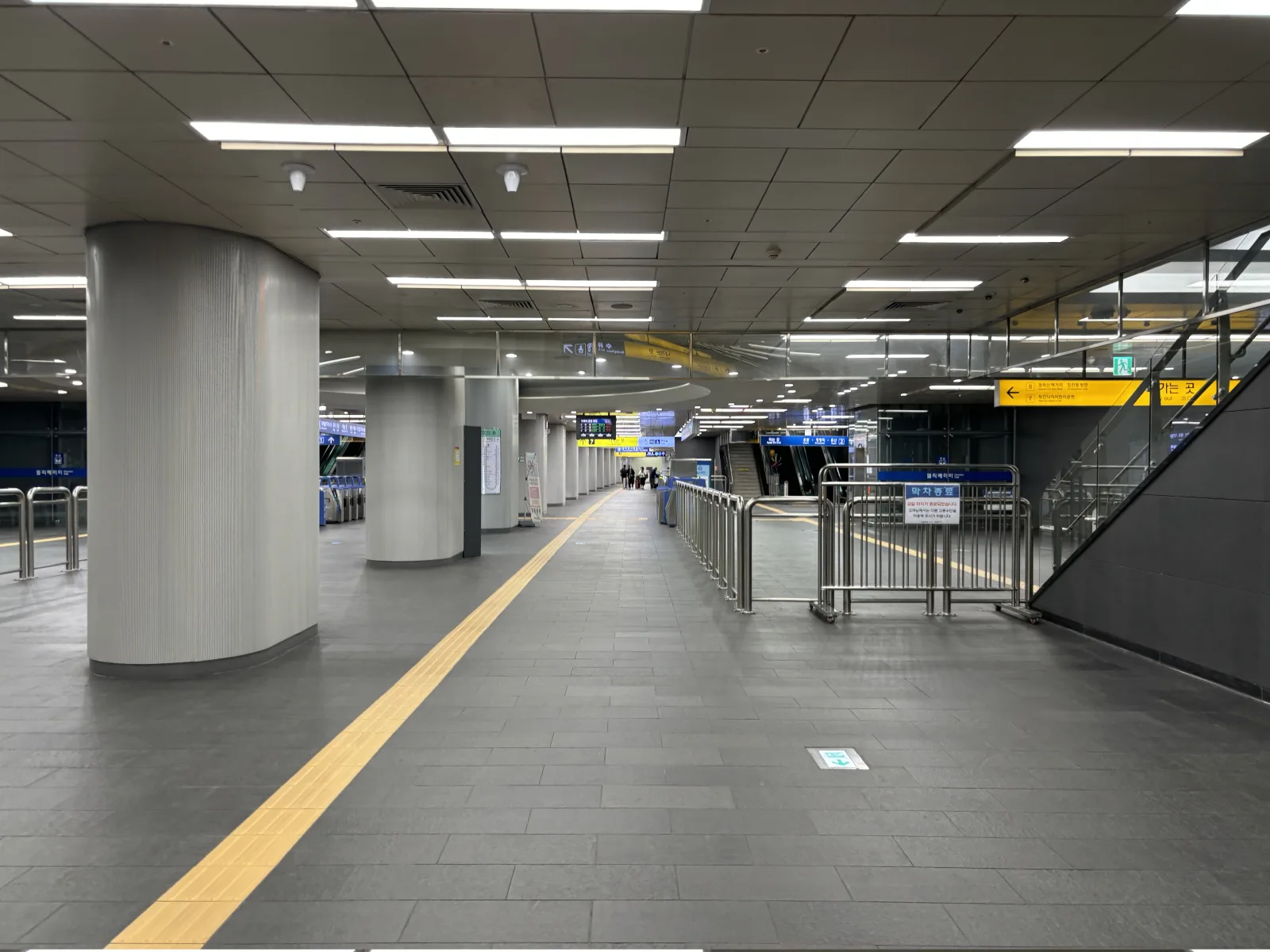
The official Seoul subway map places both stations on Line 2. For a first-time rider, skipping a transfer makes the route easier to follow. The trip is still long enough that boarding in the correct direction matters. Check the platform display or the Seoul Subway app before getting on.
| Check | Hongdae end | Gangnam end |
|---|---|---|
| Station name | Hongik University Station | Gangnam Station |
| Line used | Line 2 | Line 2 |
| Transfer | None | None |
| Main mistake to avoid | Entering the Airport Railroad side without allowing for the internal walk to Line 2 | Treating every Gangnam-area destination as if it were next to Gangnam Station |
“Gangnam” can mean Gangnam Station, the wider Gangnam District, or another southern Seoul destination such as Samseong or COEX. Search the actual place name before assuming Gangnam Station is the right stop. If the destination is elsewhere, the best route may change.
A 39-minute train result is not the full journey
A route check at 21:13 on September 8, 2026 showed a 39-minute direct Line 2 journey between Hongik University Station and Gangnam Station. Use that as a station-to-station reference, not a promise for your travel date.
Your usable travel time has five parts:
- the walk from the hotel to the correct Hongik University Station entrance;
- the walk inside the station to Line 2 and the wait for a train;
- the train ride;
- the walk from the Gangnam platform to the correct exit;
- the street-level walk to the final destination.
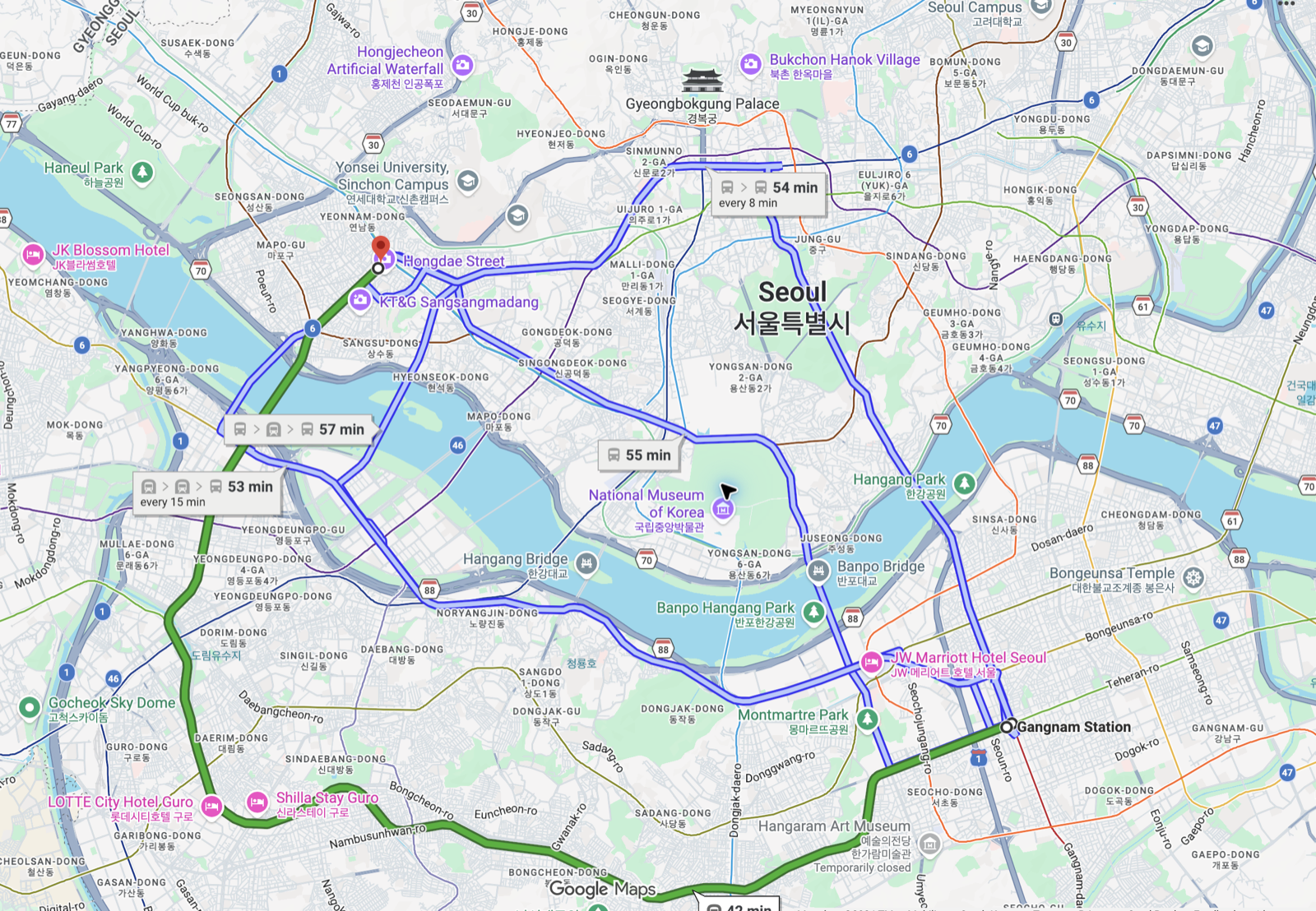
For itinerary planning, setting aside about an hour is safer than scheduling the next reservation 40 minutes after leaving the hotel. Add more room if the hotel is in Yeonnam, the Gangnam destination is not close to the station, or someone in the group needs an elevator route.
Use Naver Map or Kakao Map to search the two actual addresses, not only the station names. Then use the official Seoul Subway app to verify the train direction, timetable, passenger density, and station facilities. Check the route again at the time of day you expect to travel.
Subway or taxi: choose by the difficult part
The subway gives you a direct route and avoids road-traffic uncertainty. A taxi can reduce or remove most station walking, but replaces it with a metered fare that changes with distance, slow traffic, and late-night rules.
| Situation | Start with | Why | Check before leaving |
|---|---|---|---|
| Solo traveler with light luggage | Subway | Direct Line 2 keeps the route and cost predictable | Correct Line 2 platform and destination exit |
| Two or more travelers with heavy or awkward bags | Compare both | A shared taxi may be easier even when it is not faster | Live road time, app fare estimate, and vehicle size |
| Weekday rush hour | Subway, with extra time and flexibility | Road traffic is uncertain, but the train and stations can be crowded | Passenger density and whether you can shift departure time |
| Destination far from Gangnam Station | Search the exact address | Another station or a taxi may reduce the final walk | Nearest useful station and exit |
| Late return | Check the last useful train first | Missing it changes the decision to a taxi or another night route | Day-specific timetable and late-night taxi estimate |
Seoul’s published adult subway base fare is KRW 1,550 with a transit card and KRW 1,650 with a single-ride ticket, with distance-based additions after the base range. The exact fare for your journey should come from the route planner you use. If this cross-city trip appears repeatedly in the itinerary, use the Climate Card and T-money comparison to decide whether those rides change the better payment choice.
Standard Seoul taxis use a distance-and-time meter. The city’s published daytime base fare is KRW 4,800, while late-night surcharges apply between 22:00 and 04:00. That does not tell you the total for Hongdae to Gangnam. Check the app estimate immediately before departure because the pickup point, destination, traffic, and time all affect the result.
Rush hour changes comfort more than route complexity
The direct route does not become harder to understand at rush hour, but it can become much harder to ride with bags or a traveler who cannot stand comfortably.
Seoul Metro’s 2024 figures ranked Line 2 as its busiest line. Hongik University Station was the second-busiest station in the network and Gangnam Station was third. Across the system, 18:00 to 19:00 had the highest hourly passenger traffic, followed by 08:00 to 09:00.
Those figures do not predict the crowd level of your exact train. They do explain why a plan that looks simple on paper can feel tiring. If your schedule is flexible, moving the trip outside the main commuting periods may matter more than finding a route that saves a few minutes.
The official Seoul Subway app includes passenger-density information. Check it before heading to the platform. If you must travel at a busy time, allow a train to pass if boarding with luggage looks unsafe or uncomfortable.
Luggage and limited mobility require an exit-level check
Both Hongik University Station and Gangnam Station have elevators and accessible restrooms listed in Seoul’s station-facility information. That does not mean every entrance, passage, or exit is step-free.
Choose the accessible path before choosing the nearest-looking exit. A longer street-level walk can be easier than carrying a suitcase up stairs or crossing the station to find an elevator. The direct Line 2 route helps because it removes a transfer, but you still need to check the path from street to platform at both ends.
A taxi becomes more attractive when the station walk is the hardest part of the trip. Compare the whole group’s ability to manage the route, not only the number of bags. Save the destination’s Korean name and address so the driver or taxi app points to the correct entrance.
One Gangnam day rarely requires a Gangnam hotel
Hongdae can still work well when Gangnam is one part of a broader Seoul itinerary. Keeping one hotel may be more useful when the rest of your fixed plans begin or end near Hongdae.
Repeated trips are where the hotel decision starts to look different. Two Gangnam days do not automatically mean you should move hotels, but they are enough to compare the actual trade-off.
| Your itinerary | What to compare |
|---|---|
| One flexible Gangnam visit | Keep Hongdae if its airport access and evenings suit the rest of the trip |
| Two or more long Gangnam days | Add the repeated door-to-door travel and late returns before choosing the hotel |
| Early appointments south of the river | Compare a Gangnam hotel with the cost and inconvenience of early cross-city travel |
| Late nights in Gangnam | Check the return timetable and taxi estimate before treating Hongdae as the easier base |
Use Where to Stay in Seoul: Myeongdong vs Hongdae vs Gangnam if the commute is changing your accommodation choice. If Dongdaemun is also on the shortlist, compare it with Hongdae in Dongdaemun vs Hongdae: Where Should You Stay in Seoul?.
Check the return before a late night in Gangnam
Do not copy a last-train time from an old article. The last useful train depends on the day, the direction, service changes, and where you need to go after reaching Hongik University Station.
Before leaving Hongdae, open the current timetable and check:
- the final Line 2 departure that reaches Hongik University Station;
- the time needed to walk from the Gangnam venue to the platform;
- the exit-to-hotel walk after you return;
- a taxi-app estimate as the backup;
- the correct Korean hotel address.
Seoul’s standard taxi surcharge period begins at 22:00 and ends at 04:00, with the surcharge rate changing by time band. A late taxi may still be the right decision, but it should be a planned cost rather than a surprise after the subway closes.
Make the decision with two real addresses
Search from your hotel entrance to the exact Gangnam destination at the time you expect to leave. Then run the return route at the expected finishing time.
Choose the subway when the station walks are manageable and you value predictable movement across the city. Compare a taxi when bags, mobility, group size, weather, or the late hour makes those walks the main burden. If most fixed-time plans are south of the river, especially early or late, Gangnam may be the more practical base. Otherwise, Hongdae can still justify the commute.
Before saving the plan, record the useful station entrance, destination exit, door-to-door allowance, last useful train, and taxi backup. That one check answers more than a generic distance between Hongdae and Gangnam.
Official sources
- Visit Seoul: Hongdae
- Seoul Metropolitan Government: Subway
- Seoul Metropolitan Government: Public Transportation
- Seoul Metropolitan Government: Seoul Subway app for international visitors
- Seoul Metropolitan Government: 2024 Seoul Metro passenger data
- Seoul Metropolitan Government: Taxi fares
- Seoul Metropolitan Government: Taxi use guide
- Seoul Metropolitan Government: Subway accessibility facilities
Image credits
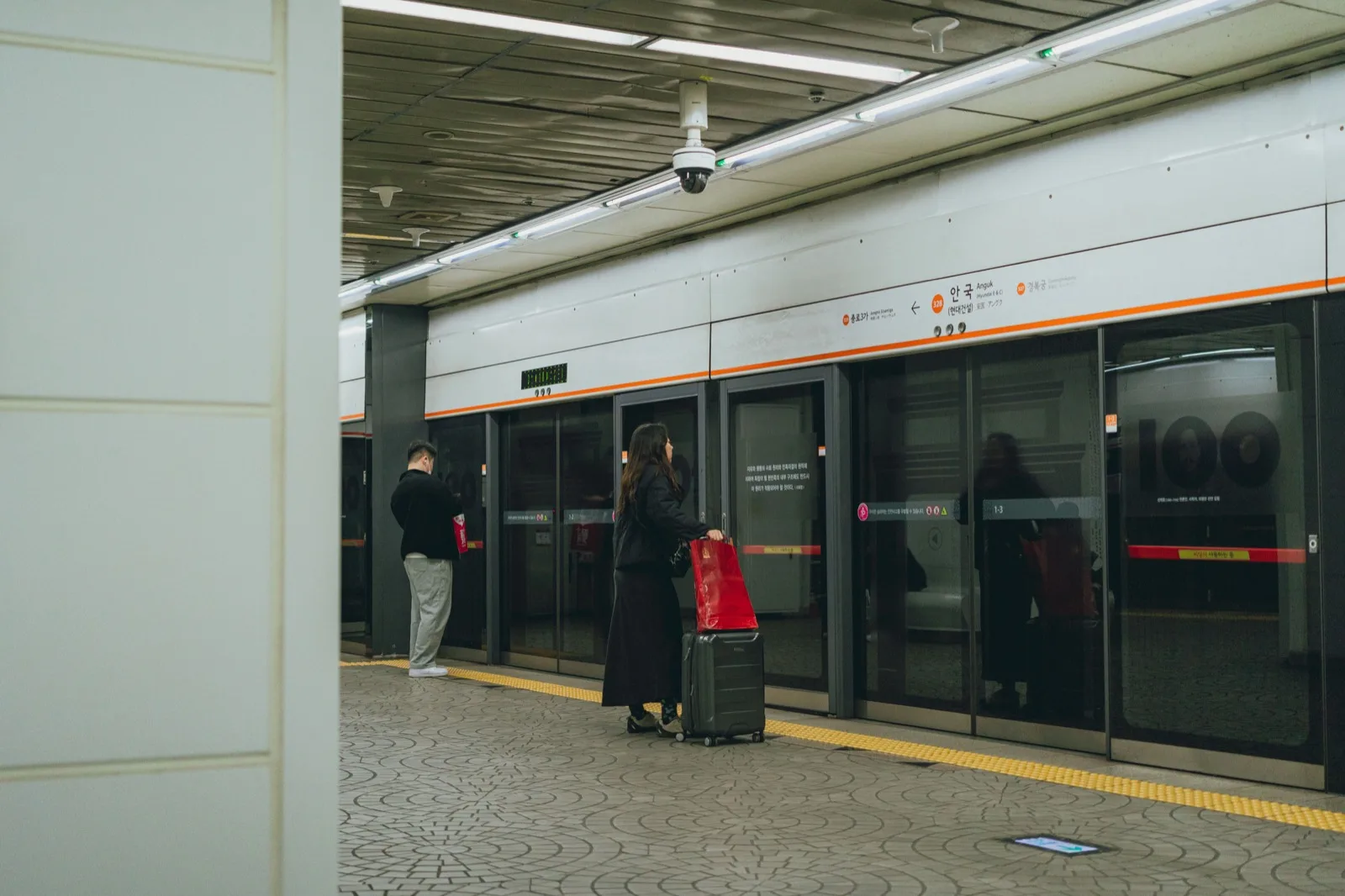
- Seoul subway platform with a traveler and suitcase — Photo by Theodore Nguyen on Pexels, Pexels License. Resized to 1600px and converted to WebP.
- Hongik University Station concourse — Photo by MNXANL on Wikimedia Commons, CC BY-SA 4.0. EXIF orientation corrected, resized to 1600px, and converted to WebP.
- Route context screenshot — User-supplied Google Maps capture, Google Maps Geo Guidelines. Resized to 1600px and converted to near-lossless WebP without cropping, recoloring, or overlays; attribution is retained beside the image.
