The easiest luggage-storage choice in Seoul is usually the one that keeps you moving toward your final train, airport transfer, or evening plan. A free hotel hold can be a poor choice if it sends you back across the city. A paid locker beside your departure station may save more time, even if it is not the cheapest option.
Quick answer: choose by route, bag size, and retrieval risk
Use your hotel when it is on the route and the property confirms that it will hold the bag for the full period you need. Use a subway locker for a short, self-service stop when you have checked the bag’s dimensions, the station access hours, and current availability. Choose staffed T-Luggage when the suitcase is large, you prefer a reservation and human handoff, or you need same-day delivery. Keep a nearby staffed or hotel fallback whenever a missed retrieval could threaten a KTX train or flight.
Do not start by asking which service is cheapest. Mark your last sightseeing stop and departure point first. The wrong storage location can add two extra station journeys to an otherwise simple day.
First, understand T-Locker and T-Luggage
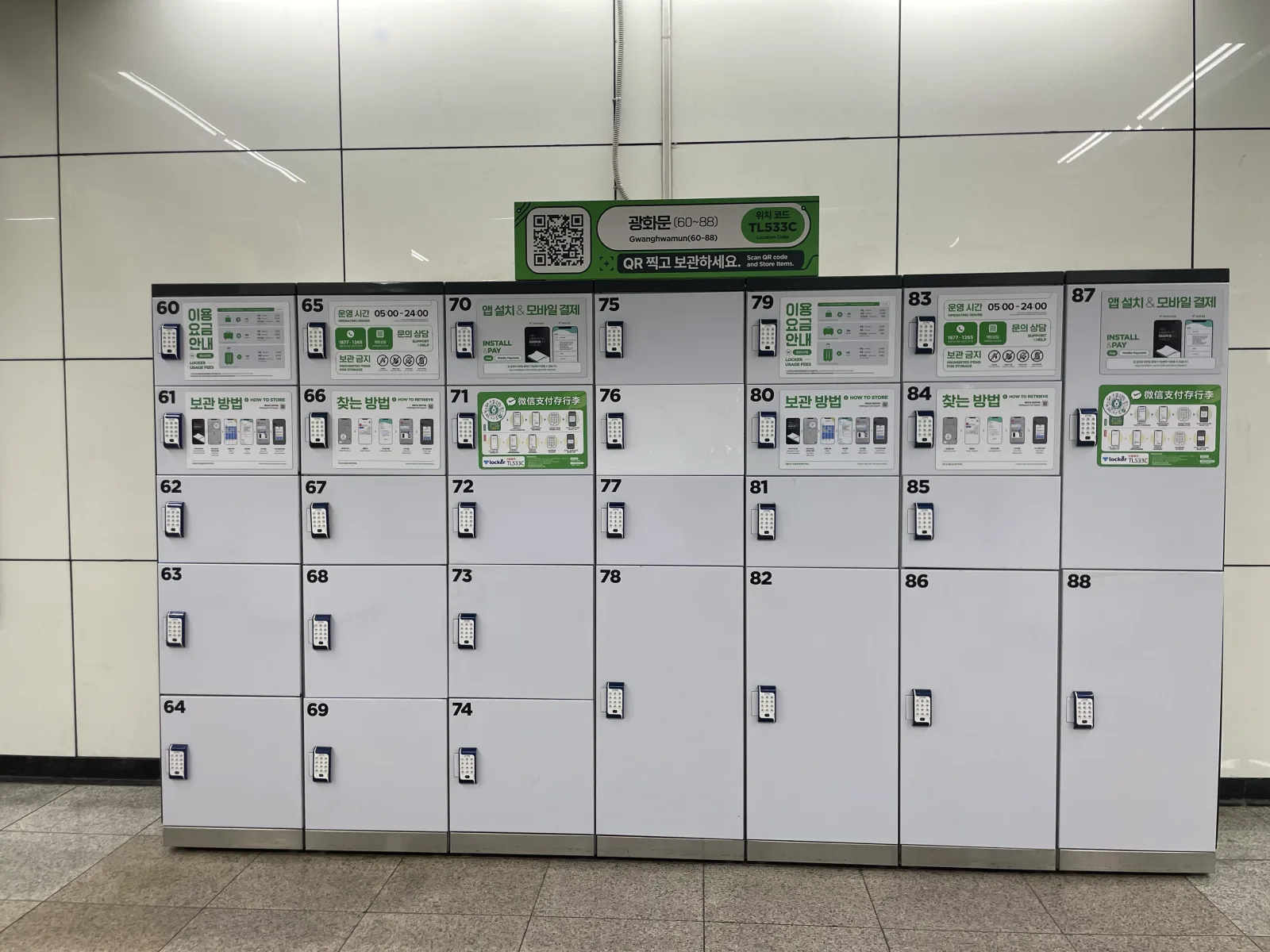
T-Locker is Seoul Metro’s self-service locker system inside subway stations. You leave and retrieve the bag yourself. Newer lockers use the Korean-only T-Locker app to show availability and handle payment and access; older locker banks may use instructions posted on the machine. Think of it as a short-stop option with no staffed counter.
T-Luggage is a staffed storage and same-day delivery service at selected transport hubs. Instead of finding an empty compartment, you take the suitcase to a service counter. The service has size categories for larger bags, and you can reserve storage or delivery online. It is not present at every station, and its staffed hours are narrower than the subway’s operating day.
The similar names cause confusion. T-Locker means a self-service compartment. T-Luggage means a staffed handoff, with delivery available on eligible routes. T-Storage, which also appears on Seoul’s official page, is intended for monthly storage and is not the normal answer for a few sightseeing hours.
Compare lockers, T-Luggage, hotel storage, private services, and delivery
| Option | Best fit | Main advantage | What can go wrong | Check before travel day |
|---|---|---|---|---|
| Hotel storage | The hotel is near your final route and confirms the full storage period | May avoid learning another system and may be free | The policy may not cover overnight or multi-day storage; returning to the hotel may create a large detour | Ask about dates, pickup deadline, fees, and whether a future stay is required |
| T-Locker | A few hours near a subway station with a bag that fits | Self-service and available across many stations | Large compartments may be full; the app is Korean-only; retrieval stops outside operating hours | Measure the bag, check availability, save the exact locker location, and identify a staffed backup |
| T-Luggage | A large suitcase, a planned station handoff, or a traveler who wants staffed service | Reservable storage with large-size categories and delivery options | Only selected centers are available, and function-specific hours may differ | Confirm the center, date, size tier, opening hours, reservation email, and pickup deadline |
| Private storage | The official options do not fit the route or hours | May provide a useful neighborhood or late-hours fallback | Terms, insurance, access, and merchant identity vary | Verify the exact shop, opening hours, bag limits, cancellation terms, and coverage |
| Same-day delivery | Returning to the original storage point would waste substantial time | Moves the bag toward another hub or the airport while you continue sightseeing | A cutoff, endpoint restriction, or delay can separate you from essential items | Check both endpoints, handoff cutoff, expected pickup window, delay terms, and a time buffer |
The route test
Count four legs: reaching the storage point, walking through the station with the bag, returning for collection, and continuing to the final departure point. A service beside “Seoul Station” can still require a long underground walk from the line or platform you use. When the hotel sits near your evening airport-bus stop, leaving the bag there may win. When your hotel is in Hongdae but your KTX leaves from Seoul Station, moving the bag toward the train earlier can be easier.
Check the whole bag, not only its inch label
Seoul’s official guide publishes T-Locker compartments as width × depth × height:
| T-Locker size | Published compartment dimensions |
|---|---|
| Small | 50 × 30 × 60 cm |
| Medium | 50 × 45 × 60 cm |
| Large | 50 × 90 × 60 cm |
Measure the suitcase at its widest points, including wheels, side handles, and any expanded pocket. A “27-inch suitcase” is a product label, not a promise that its outside dimensions match a locker opening. Soft bags can also bulge beyond their nominal size.
If the measurements are close to the published limit, treat the locker as uncertain. T-Luggage uses staffed size bands extending to 27 inches and above, but the live booking page still needs to accept the exact item and center. A staffed reservation is the safer starting point for an oversized case, a non-standard item, or luggage you cannot comfortably take to a second location.
Plan for full lockers, closed counters, and phone trouble
A locker plan is not complete until you know what you will do when the large compartments are occupied. Save a second option within a manageable walk before you arrive. In major visitor areas, that might be a T-Luggage center or confirmed hotel storage. A random locker bank at another station is a weak backup if reaching it requires another transfer with the suitcase.
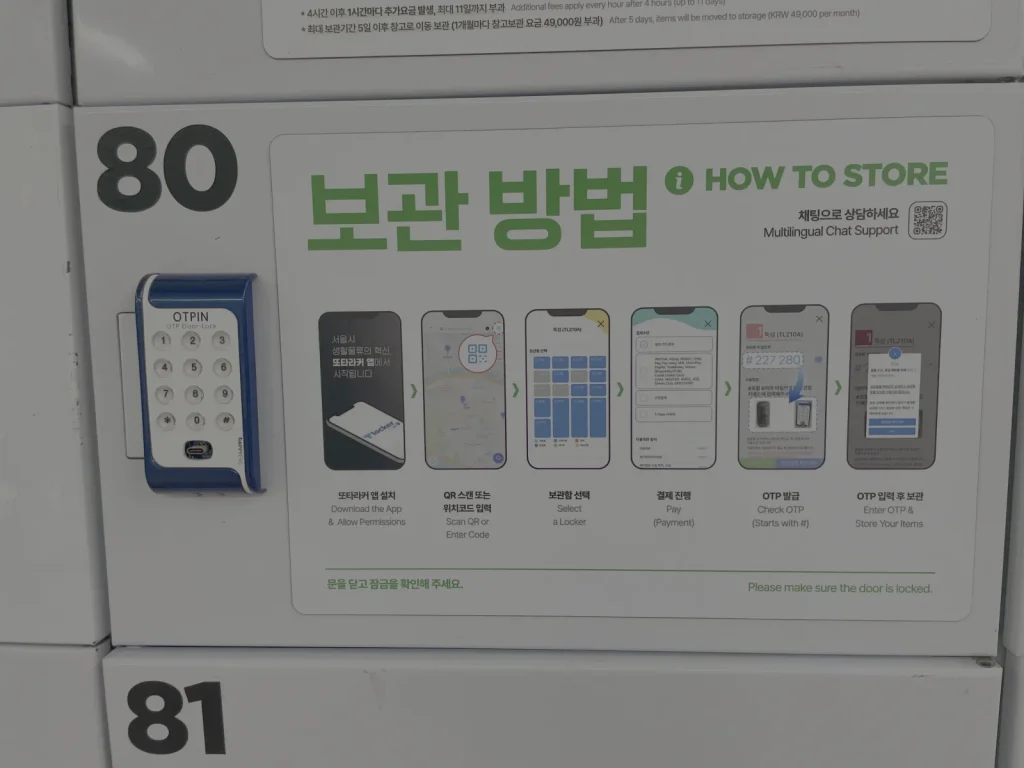
The official Seoul guide says newer T-Lockers can be checked through the T-Locker app, which is available only in Korean. Older machines may have different on-site instructions. If you are not comfortable completing an unfamiliar Korean interface under time pressure, choose staffed storage or test the app before travel day.
T-Locker support is listed as Korean-language support, and official guidance says on-site help may take up to two hours and may carry a service fee when the issue is user-related. Do not set your locker pickup immediately before the last reasonable train or airport connection.
How pricing works, and why storage time matters
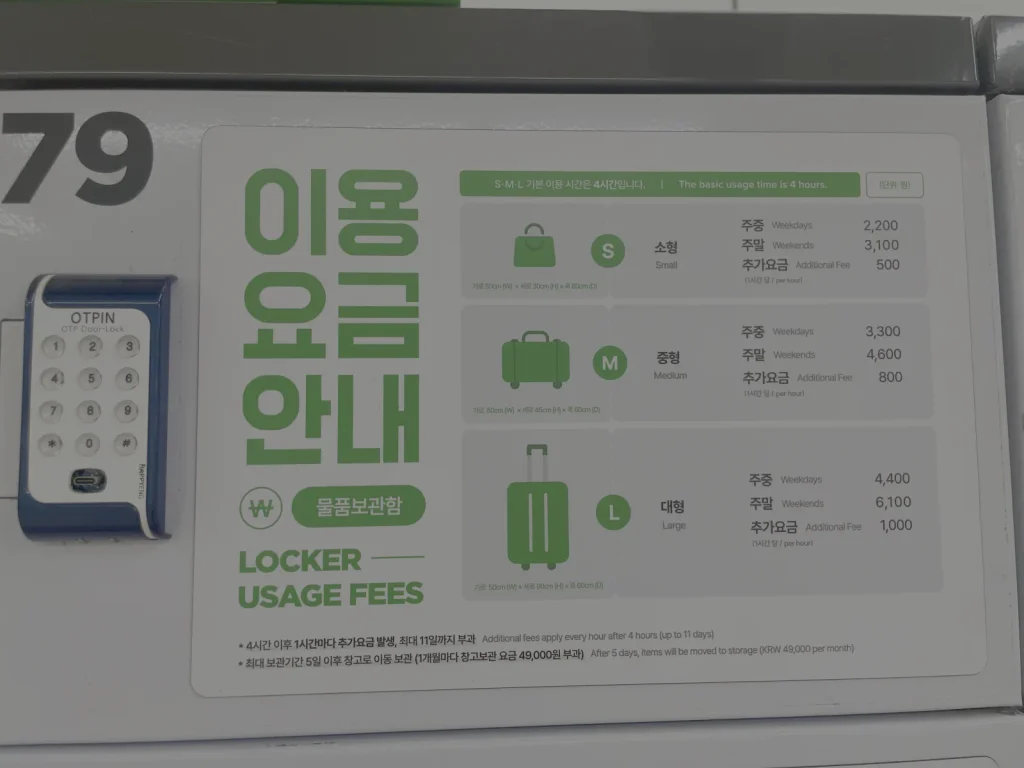
Both T-Locker and T-Luggage start with a four-hour base charge, then add an hourly overage. That is why you should calculate the time from drop-off to your realistic return, not just compare the number printed as the base price.
As checked on September 15, 2026, the official T-Locker weekday base rates were KRW 2,200 for small, KRW 3,300 for medium, and KRW 4,400 for large; weekend bases were higher. The same page listed access from 5:00 AM to midnight and warned that storage and retrieval are unavailable outside those hours. Recheck the official page and the machine before relying on either the price or access window.
T-Luggage also uses four-hour size bands and hourly overage for staffed storage. Its published categories run from bags up to 20 inches through an extra-large tier starting at 27 inches. The official city page lists staffed service from 9:00 AM to 10:00 PM, but some operator pages show function-specific times. Confirm the selected center and service on the reservation screen rather than assuming one timetable applies everywhere.
For a full day, compare the total overage and the return route. For overnight or multi-day storage, do not extrapolate hourly pricing or assume a locker can remain accessible for the whole period. Ask the hotel or chosen operator to confirm that exact date range and collection time in writing.
Use delivery only when it removes a return detour safely
Same-day delivery helps when it saves a return trip. For example, leaving a bag at one T-Luggage point and collecting it near the airport route can remove a long journey back to the original counter. It adds little when your sightseeing and departure already pass the storage point.
The T-Luggage guide supports on-site and online delivery registration. It asks travelers to check drop-off and pickup times, sends online reservation confirmation by email, and warns that delivery can be delayed. Because the English timing tables are not consistently formatted, use the live reservation result for your date and endpoints. Do not place medication, passports, the only warm layer, or anything needed during a delay in a delivered suitcase.
Leave a generous buffer between the expected arrival of the bag and your final check-in or train. If the itinerary cannot absorb a delay, keep the bag with you or use storage that you can retrieve directly.
Save a retrieval record before walking away
Before leaving the bag, save the following offline:
- the station, floor, exit direction, and a photo of the exact locker bank or counter;
- the locker number or reservation number;
- the receipt, QR code, or confirmation email as a screenshot;
- the closing time and your planned pickup time;
- the support contact and one nearby fallback;
- a list of essentials kept with you.
Then set a collection alarm with enough time for one failed attempt. This small step matters more than finding the lowest base price because it keeps a storage problem from becoming a missed departure.
Related Seoul guides
- Incheon Airport to Seoul: AREX, Airport Bus, or Taxi? — Choose the airport route that fits your luggage, hotel area, arrival time, and group.
- 3 Days in Seoul: A Practical First-Time Itinerary — Place the luggage plan inside an area-based route that avoids unnecessary cross-city travel.